Problem
Place-based source material needed a coherent journey that remained readable, reversible, responsive, and usable with keyboard or reduced motion.
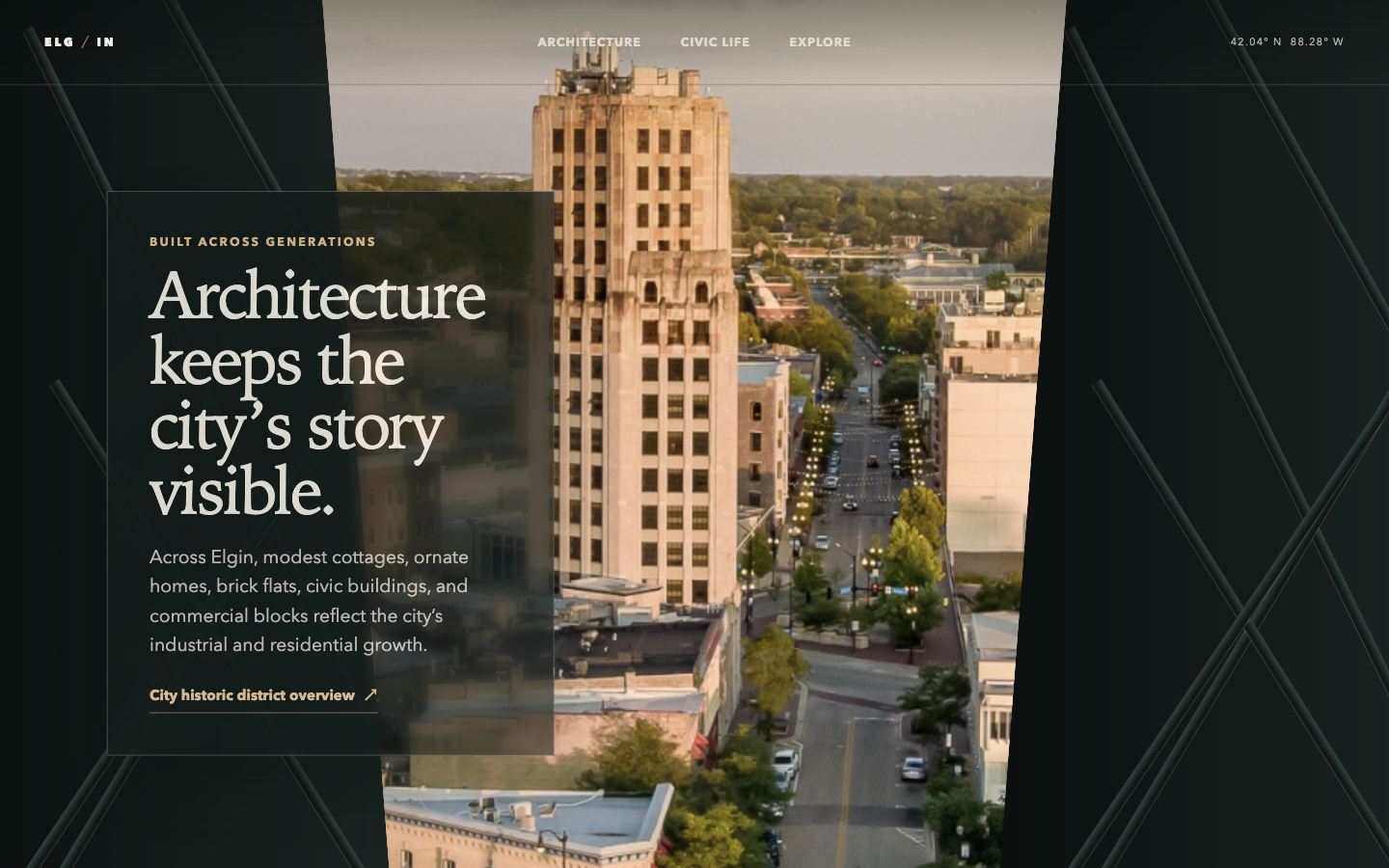
A scroll-driven editorial portrait of downtown Elgin, the Fox River, local architecture, public space, and cultural life—designed as a reversible, responsive experience rather than a conventional information page.
Project at a glance
Place-based source material needed a coherent journey that remained readable, reversible, responsive, and usable with keyboard or reduced motion.
Set product direction and narrative, directed AI-assisted implementation, reviewed responsive behavior, and validated the local experience.
AI-assisted development supported component and styling drafts, timeline implementation, test scaffolding, QA analysis, and packaging.
The recorded local review covered five screen sizes, two rendered HTML tests, deterministic reverse movement, and no overflow at the reviewed sizes.
Unpublished local project, not an official City product. Six curated views are not comprehensive; review is bounded and not formal accessibility certification.
The opportunity
A list of landmarks can communicate facts without conveying how a city’s river, streets, buildings, public spaces, and cultural life relate. The design challenge was to turn place-based source material into a coherent digital journey.
Build an expressive experience that remained deterministic, reversible, readable across screen sizes, and usable when motion is reduced or a visitor navigates without a mouse.
What Christian designed
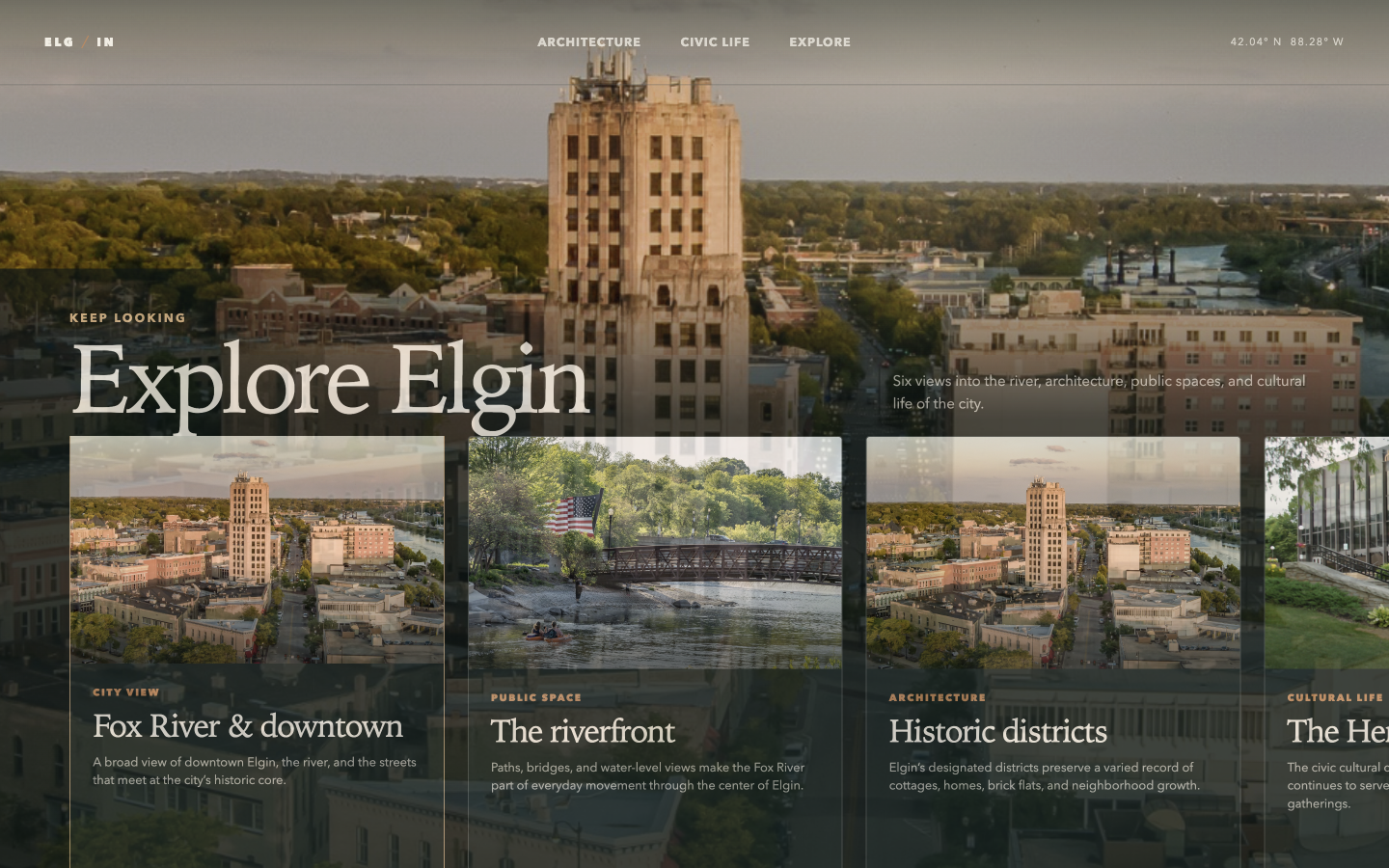
A sticky visual stage translates scroll progress into explicit scene states. Narrative panels enter, hold, and exit at defined points; camera framing and image treatment respond to the same timeline; and the final feature rail opens six sourced views into Elgin.
Pure scene calculations turn bounded progress into repeatable opacity, scale, position, tint, blur, and brightness values. Moving backward restores prior states instead of leaving the interface in an uncertain condition.
Contribution
Christian set the product direction, selected the narrative and interaction goals, directed AI-assisted implementation, reviewed scene behavior and responsive framing, and validated the final local experience and static review package.
AI and tools
AI-assisted development supported component and styling drafts, timeline implementation, test scaffolding, QA analysis, and packaging. Christian retained authority over scope, source selection, design decisions, revisions, and acceptance.
Design and technical decisions
Explicit functions calculate each scene from progress, so forward and reverse movement produce predictable states.
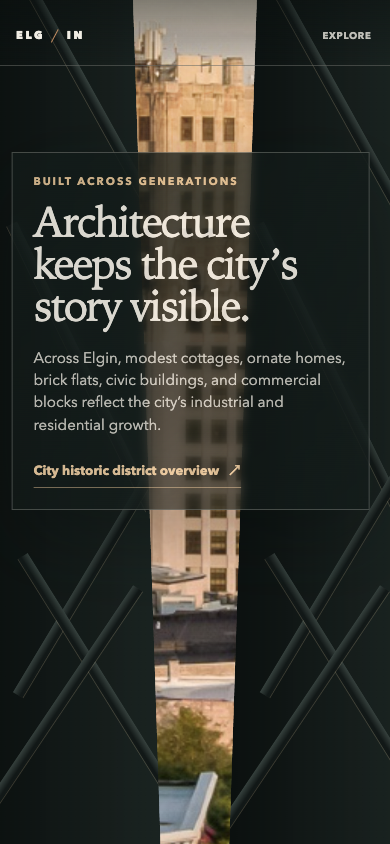
Desktop, laptop, tablet, and mobile compositions preserve narrative hierarchy without horizontal overflow.
The feature rail supports visible controls, Arrow-key navigation, pointer drag, focus retention, and live-region updates.
A dedicated reduced-motion presentation removes the long cinematic scroll while retaining the content and exploration path.
Evidence and validation
These checks establish implementation behavior—not public adoption, official endorsement, or business impact.
Production build, TypeScript, lint, deterministic timeline checkpoints, reverse progress, keyboard interaction, pointer drag, assets-ready state, and reduced-motion behavior passed in the recorded validation.
The experience is an unpublished local project, not an official City of Elgin product. Its six views are curated rather than comprehensive. Browser review is bounded and is not formal accessibility certification.
Place-based storytelling becomes easier to follow when motion, narrative, source links, and exploration share one explicit state model.
Add a broader assistive-technology review and test whether a lighter asset strategy can preserve the same art direction on slower devices.