Problem
AI-prepared workflow language can omit context, overstate certainty, or suggest actions that require human authority. The reviewer needs evidence and risk beside the exact wording.
A focused local work sample for reviewing four fictional dealership scenarios. Inspect the context, edit a draft, then record a human decision. The demo never sends or updates anything.
Project at a glance
AI-prepared workflow language can omit context, overstate certainty, or suggest actions that require human authority. The reviewer needs evidence and risk beside the exact wording.
Defined the synthetic workflow, review decisions, safety boundaries, user-facing copy, and acceptance criteria; directed and reviewed AI-assisted implementation.
AI assistance supported coding, test drafting, and documentation. The demo’s safer rewrite is fixed and deterministic, with no model call at runtime.
Four fictional cases and 11/11 local behavior and regression checks passed on October 5, 2026. See the interactive demo and current check record.
The interactive demo uses in-memory state only; it has no persistence, authentication, external API or customer-system calls, live AI, CRM, email, or external action. This personal work sample is not a customer deployment or production system.
Narrated walkthrough · 57 seconds
A short tour of the same local, synthetic prototype available to explore below.
The text below is the approved audio narration. “This page” refers to the interactive demo shown in the video.
This is a small, local work sample built around four fictional dealership review cases. I select a case to see the context, the risk, and the draft that needs attention. The rewrite button applies a fixed, case-specific safer version; it does not call an AI service. I can edit the wording, then approve that exact text for this local review, reject it, or escalate the case.
One credit-sensitive case stays blocked from approval even after its wording is revised. If approved wording changes later, the earlier approval is cleared. The session history records review actions, and the JSON export includes decision metadata while leaving out editable draft text. Reset restores the four original fictional cases.
Nothing is sent. The demo runs in this page only, with no customer data, CRM, phone, email, AI provider, or production connection. It demonstrates a human-review workflow prototype, not a customer deployment.
The problem
AI-prepared workflow language can omit context, overstate certainty, confuse recipients, or suggest actions that require human authority. Reviewers need the evidence and risk beside proposed wording—not hidden in a separate log.
Create a visible gate where a reviewer can inspect a fictional scenario, edit the exact wording, reject it, or stop and escalate before any hypothetical next step.
The design
The demo shows a selectable queue, evidence and uncertainty, editable drafts, deterministic safer rewrites, exact-text approval, rejection, stop and escalation, in-memory history, synthetic export, and reset.
Approval records a local in-memory review state only. Nothing is sent, no live system is updated, and the credit-sensitive case cannot be approved.
Change the text after approval to see the decision become stale; try the blocked case; inspect the history and export boundaries.
Contribution
Christian defined the domain problem, human-oversight objective, required review decisions, safety constraints, prototype boundaries, and public-evidence standard. He directed and reviewed AI-assisted implementation and validation under those constraints.
AI and tools
AI-assisted coding supported the static application, test drafting, and documentation. The rewrite inside the demo is deterministic; AI is not called while the demo runs.
Evidence and validation
These checks apply only to this dated, separate work sample. They do not validate the older public dashboard screenshots or establish customer results or production readiness.
The local checks cover queue selection, deterministic rewrite, exact-text approval, approval invalidation after edits, blocked approval before and after rewrite, rejection, escalation, export that omits draft text, reset, and unknown IDs. The regression check verifies RC-101/RC-102 fixture flags, the app’s hidden-attribute mapping, and the CSS rule order. Separate October 5 browser QA confirmed the rendered states: RC-101’s warning is absent and approval is available; RC-102’s warning is visible and approval stays disabled before and after rewrite. Reset and history worked, and desktop and 400px mobile showed no horizontal clipping. This is not a screen-reader review or accessibility certification.
Read the current check record. Read the earlier October 4 record.
This is a narrow, local personal prototype. It has no authentication, persistence, live integration, production control plane, or customer deployment. It does not establish business impact or certify accessibility. The four cases are fictional.
The images below are from an earlier public dashboard case-study version. They are preserved as historical concept evidence and do not depict the new focused demo linked above. The prior app source and its legacy checks are not available in this working copy, so no legacy test totals, technology stack, or viewport-review claims are repeated here.
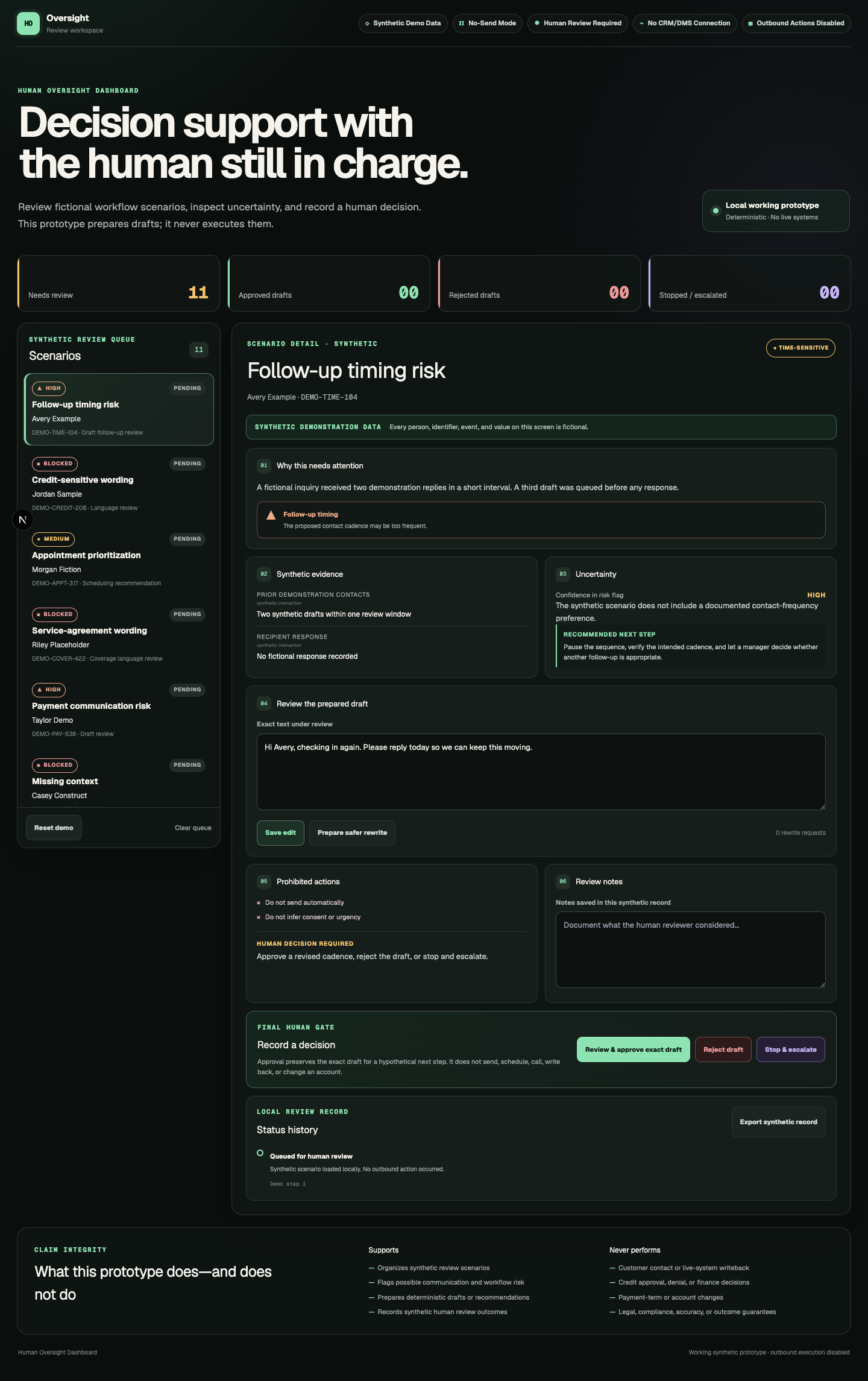
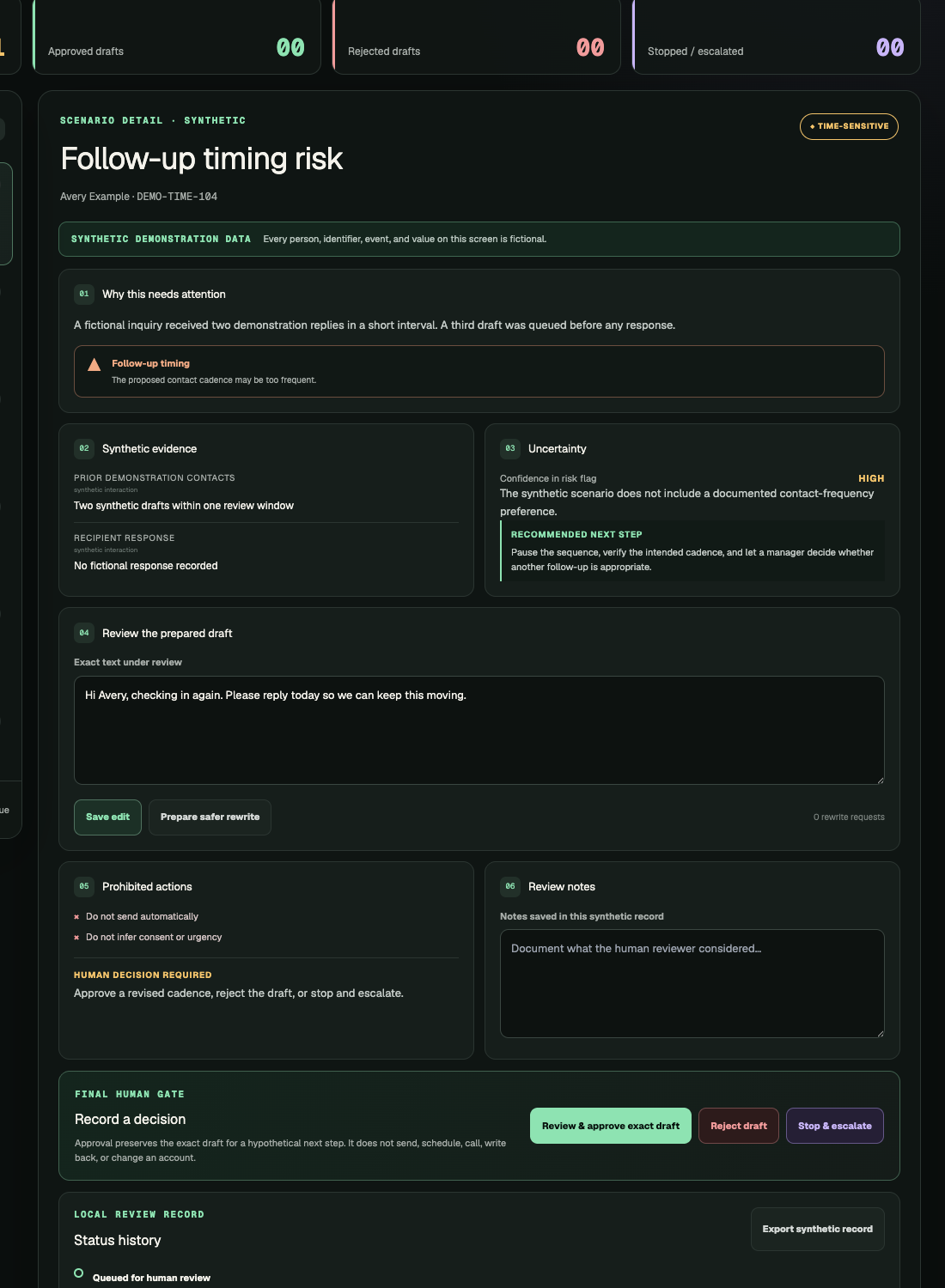
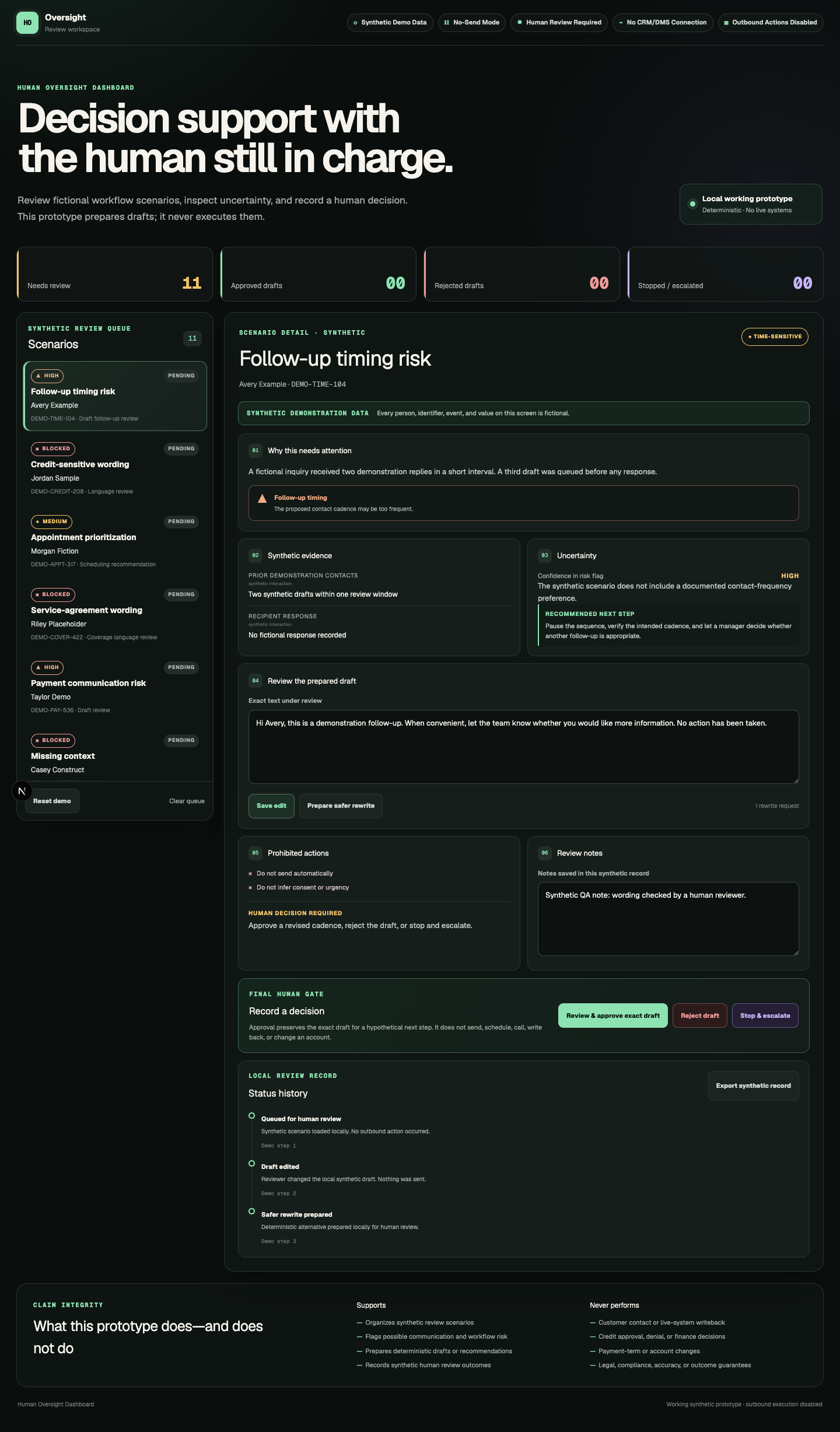
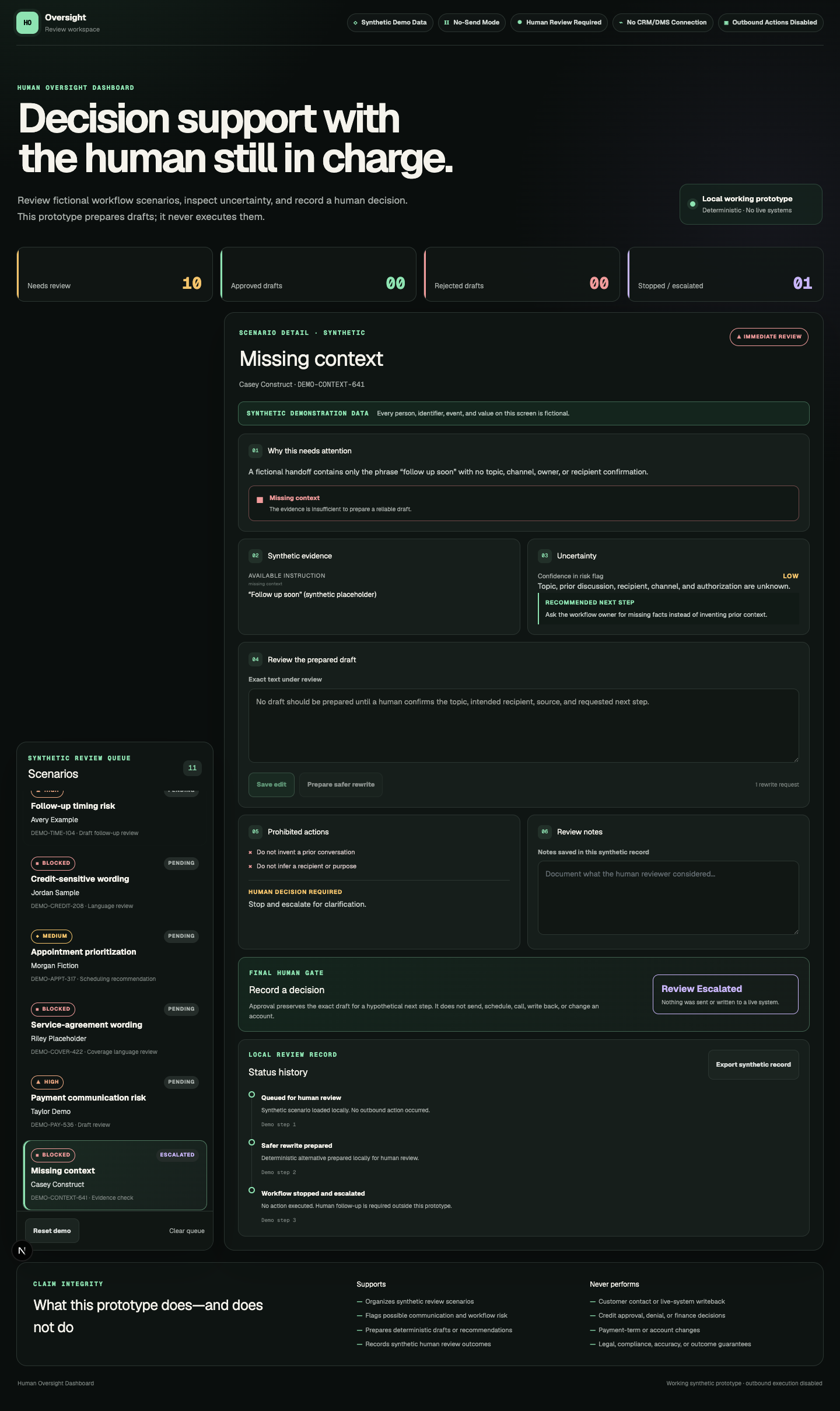
Human review is easier to understand when evidence, uncertainty, exact wording, prohibited actions, and the decision record appear in the same workflow.
In a synthetic environment, add broader keyboard and assistive-technology review, then consider role separation and durable policy-governed records without weakening the no-send boundary.